Showing posts with label Treating Childhood Sicknesses. Show all posts
Showing posts with label Treating Childhood Sicknesses. Show all posts
Thursday, 13 May 2010


Saturday, 8 May 2010
Dealing with Eczema

As a child of I myself suffered for sometime with Eczema. My Mother believes it was emotionally related, if I ever got angry or upset I would flare up raw red in patch's mostly behind the knees and ears. This disappeared as soon as I reached my early teens, didn't have any treatment as far as I remember neither.
Unfortunately my daughter Tulá has also been diagnosed early on in her little life with what they call "baby Eczema". It started as just a few spots here and there, then it kept spreading all over her face, arms, legs and head. Whenever my daughter Tulá, has a bath she develops red blotches all over her body, she also flares up when she gets upset.
I hate seeing her so sore and irritable. She can't be left alone and naked at all, she will scratch herself till she bleeds. We had to insure her hands were covered with mittens every night before bed, otherwise she would scratch herself during the night. This has also effected her sleeping and her general happiness I believe.
Her legs were all scratched ankle to knee up until 3 weeks ago, when I was determined to battle this illness and make her more comfortable.
We have tried everything, E45, Vaseline, Jojoba oil, Bert Bees, pure refined coco butter, refined Shea butter Hydrocortisone 1% cream, Elocon cream and finally Aqueous cream and Cetraben emollient cream.
None of these products seemed to work. We stopped using the Hydrocortisone 1% cream due to the side affects I had read up on. The butters and Jojba oil were recommended by my brother in- law who's daughter also suffered with Eczema and he found combining the all 3 helped. For a short while we thought it was helping too, it was only making her feel slightly soft for an hour or so then back to the dryness and the serve itchiness if not applied almost every hour.
We stopped bathing her every evening 4 weeks ago, only top and tailing her day and night and bathing her 3 times a week. We started to use the Aqueous cream as a wash recommend by our GP and the Cetraben emollient cream as her all over moisturiser. Again her skin became much better but still she was uncomfortable and itchy. On Mothers day I actually had to call the doctors due to her excessive itching all day. I then stated to continue using the Aqueous cream as a wash and then combined the Aqueous cream and the Cetraben emollient cream together and hey presto! It's worked! all gone my Princesses is no longer itchy, no longer red and no longer dry and uncomfortable. Just silky baby smooth.
Her legs were all scratched ankle to knee up until 3 weeks ago, when I was determined to battle this illness and make her more comfortable.
We have tried everything, E45, Vaseline, Jojoba oil, Bert Bees, pure refined coco butter, refined Shea butter Hydrocortisone 1% cream, Elocon cream and finally Aqueous cream and Cetraben emollient cream.
None of these products seemed to work. We stopped using the Hydrocortisone 1% cream due to the side affects I had read up on. The butters and Jojba oil were recommended by my brother in- law who's daughter also suffered with Eczema and he found combining the all 3 helped. For a short while we thought it was helping too, it was only making her feel slightly soft for an hour or so then back to the dryness and the serve itchiness if not applied almost every hour.
We stopped bathing her every evening 4 weeks ago, only top and tailing her day and night and bathing her 3 times a week. We started to use the Aqueous cream as a wash recommend by our GP and the Cetraben emollient cream as her all over moisturiser. Again her skin became much better but still she was uncomfortable and itchy. On Mothers day I actually had to call the doctors due to her excessive itching all day. I then stated to continue using the Aqueous cream as a wash and then combined the Aqueous cream and the Cetraben emollient cream together and hey presto! It's worked! all gone my Princesses is no longer itchy, no longer red and no longer dry and uncomfortable. Just silky baby smooth.
I now generally try and go for natural products, choosing herbs over medication more often than not. But that doesn’t mean conventional medicine is entirely without merit: sometimes, outside help is recommended and required.
While researching help and advice I recently read an article on the web called Against Childhood Eczema, and wanted to share some of the key points from the article by Margaret Cox from the National Eczema Society and Dr Steve Hewitt, a skin specialist for E45
Cox gave an insightful look at eczema from the point of view of the patient (or sufferer, I would have said). Her two main points were that there are a lot of people suffering from eczema – no one is alone in this, and secondly that although the condition is not curable, it is treatable.
According to Cox, one in five children in the UK suffers from eczema, with the numbers having increased three-fold in the last 30 years. Although two-thirds of children will grow out of it, the unlucky final third will suffer into adulthood.
The reasons behind this rise are not specifically known, but among the many potential causes are obsessive cleanliness, sterilisation, bath products containing harmful chemicals, weather extremes, air conditioning and heating, sun exposure, bad diets, lack of moisturisation and hereditary factors. Also, people who are deficient in Filaggrin (filament-associated proteins which bind to keratin fibres in epithelial cells) are more prone to eczema and asthma.
Cox also spoke of the emotional impact of childhood eczema, and the stress that unpredictability about flareups and uncertainty about their duration can cause. The direct impact on children, such as the inability to swim or play outdoors, is emotionally taxing, only made worse by the stigma of other children thinking they’re contagious, and teasing them. (See the National Eczema Society website for free downloadable packs to help teachers and schools understand the condition.)
Dr Hewitt, meanwhile, stated that most GPs typically only spent a few days focusing on eczema in their medical training. This is a frighteningly inadequate when you consider that around a third of the patients they will see suffer from some level of eczema. Most GPs also seem unaware that most prescribed emollients can be quite harmful to the skin.
Dr Hewitt also spoke about the commonality of infant eczema becoming childhood asthma, and leading to adult rhinitis.
The Against Childhood Eczema (ACE) campaign suggest five steps for parents of children suffering eczema to follow:
1. Bathing – Daily bathing can cause a child’s skin to dry out. Only bathe babies twice or three times a week for the first six months, the rest of the time just topping and tailing them. When you are bathing them, make sure to use fragrance-free bath oil and avoid bubble baths to help ward off irritation.
2. Emolient – Simple, non-cosmetic moisturisers that soothe and help relieve dry and itchy skin should be liberally applied, especially at night when skin is most metabolically active, causing it to heal better.
1. Bathing – Daily bathing can cause a child’s skin to dry out. Only bathe babies twice or three times a week for the first six months, the rest of the time just topping and tailing them. When you are bathing them, make sure to use fragrance-free bath oil and avoid bubble baths to help ward off irritation.
2. Emolient – Simple, non-cosmetic moisturisers that soothe and help relieve dry and itchy skin should be liberally applied, especially at night when skin is most metabolically active, causing it to heal better.
3. Massage – Emolient application can be distressing, especially during flareups, so try to make it as relaxing and enjoyable as possible, letting toddlers watch a DVD or sing songs to keep them calm. Always apply the emollient downwards (along the hair, rather than against it).
4. Frequency – Dermatologists suggest a ‘complete emollient regime’ for treating dry skin. Use a soap substitute and a leave-on emollient two to three times a day, even when the eczema is under control.
5. Comfort – Create a calm atmosphere when applying creams. Don’t be stressed or worried as this will add to your child’s stress and worry, and cause the flareups to be worse.
4. Frequency – Dermatologists suggest a ‘complete emollient regime’ for treating dry skin. Use a soap substitute and a leave-on emollient two to three times a day, even when the eczema is under control.
5. Comfort – Create a calm atmosphere when applying creams. Don’t be stressed or worried as this will add to your child’s stress and worry, and cause the flareups to be worse.
Calpol What every Parents should know
Calpol Calpol Calpol, Why is it that that's all I hear a parent gives a their child when they are unwell, from fever, teething, crying not sleeping you name Calpol is given. I can safely say I have a hate-hate relationship with Calpol. It works like this: I hate it… and on the other hand I hate it. I have no objections to paracetamol on its own, even though I rarely use medicine, and I absolutely agree that it should have its place on our shelves, as it does serve a valuable purpose. However, in my opinion Calpol does not, and shouldn’t be on the shelves at all. Come on it's bright Pink!
And here, in brief, is why I don’t use Calpol and will never recommend it. For further information, please see ‘Behind the Label’.
You see, apart from paracetamol, Calpol also contains a few other ingredients. These include:
- strawberry ‘flavouring’ & carmoisine to produce its pink colour. (Chemical compoundE122- suspected carcinogen, banned in Austria, Japan, Norway, Sweden and the US and not recommended for consumption by children) .
- the paraben preservatives methyl parahydroxybenzoate (E218 - suspected hormone disruptor and allergen. Banned in France and Australia) andE122. Note that both these substances have been linked to hyperactivity, and the Hyperactive Children’s Support Group identifies them as likely causes of mysterious and sudden cases of ADHD-like hyperactivity. They too say these substances are not recommended to be consumed by children.
- Maltitol (a mild laxative)
- Glycerol (E422 - large quantities can cause headaches, thirst and nausea)
- Sorbitol (E420 - There are no limits to the intake of E420; however, its use is actually prohibited for infants younger than 1 year of age, as it may cause severe diarrhoea)
- Propyl parahydroxybenzoate (E216 - suspected hormone disruptor and allergen. Not recommended for consumption by children . Possible contact allergen. Not permitted for use in France or Australia)
- Ethyl parahydroxybenzoate (E214 - suspected hormone disruptor, banned in France and Australia. Not recommended for consumption by children)
- A thickener – xanthan gum (E415- no known adverse effects)
Unfortunately, Calprofen, the Ipubrofen alternative, is hardly any better.
As adults, we go out of our way to avoid foods with too many of the so-called ‘E Numbers’, and as parents we’re told to provide our chidren with healthy, balanced diets.
And yet, here we are happy to load up our children on E numbers through over-the-counter medicine. Let’s put it another way: our response to a health problem in our child is to feed them potentially dangerous substances that we are specifically advised they shouldn’t have.
From a more international perspective, it greatly disturbs me that here in the UK we are giving our babies a product that includes substances that are actually banned in Austria, Japan, Norway, Sweden, the US, France and Australia. Even more disturbing is that when I asked a GP for an alternative to Calpol or Calprofen without all the additives (as is found in many other countries), he did not know of any, and recommended I speak to the pharmacist. The pharmacist had no idea either and referred me back to the GP.
Side effects of Calpol may include hives, rash, short breath and prolonged or habitual use may lead to liver damage or failure. I gave my daughter Calpol twice and each time her skin broke out in red and patchy blotches. I know she’s not alone in this. There have also been suggestions in the past of a link between Calpol and asthma, hayfever and eczema.
But what if my baby has a fever?
A fever, believe it or not, is a good thing. It is the body’s way of getting rid of an infections. A fever that is too high is dangerous and should be treated (with paracetamol, for example), but administering Calpol for every little thing reduces the body’s natural immunity and prevents the body from fighting off the infection, leading to what seems like a never ending reoccurring cycle of illness.
Angela England has some great advice on treating a mild fever naturally. Some of her suggestions include herbs, essential oils, homeopathy, rest, food and fluids.
It is an exceptionally difficult thing, seeing your child suffering and in pain. But we all have to go through teething and growing pains. We all have to learn to stave off fevers and to extend our pain threshold. It’s part of building our immune system, so long as it is managed sensibly.
Yet leaving all that aside, the most disturbing part of this whole affair is the complete lack of any kind of real alternative. Why is the only option put forward seemingly by the UK’s entire medical community a substance that fills our children’s bodies with things that are documented to have the ability to cause more harm than good?
It is a question I’d love to see answered, but suspect I never will.
Disclaimer: I am not a doctor. I write only my thoughts. I stand by my thoughts and my research and my decisions for myself and my family, but you have to make your own decisions for you and yours. I am not advocating ignoring a fever, but I am asking more parents to stand up and request, no, demand an alternative that isn’t bad for our children.
Friday, 7 May 2010
Teething and the Amber beads

Despite its appearance, amber is actually a resin, not a stone, and is therefore a plant residue which is warm to touch and light to wear. There are two theories as to why amber works:
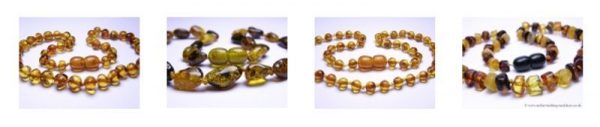
One suggests that when amber is worn on the skin, the skin’s warmth releases minuscule amounts of healing oils from the amber which are then absorbed via the skin into the bloodstream.
A second theory is based on scientific findings, which have shown that amber is electromagnetically alive and therefore charged with a significant amount of organic energy. Its special attribute is the fact that it is electronegative. Wearing amber produces negative ionisation on the skin’s surface. This, in turn, has a positive influence on the human body. The negative ions assist in the in the prevention of illness. These health-promoting effects apply to babies, children and adults alike.
I must admit that I was a bit sceptical at first, but after three days of pretty constant crying, I was ready to try anything. Within half an hour of placing the necklace around her neck, the crying stopped, but the drooling and gnawing continued. Someone suggested to me that the necklace might have a placebo effect, but that certainly doesn’t make sense if it actually works on babies, since they don’t know what it’s supposed to be doing and yet are positively affected. And there are plenty of mothers who say the same.

Amber Teething Necklaces offer exactly that: a wide range of necklaces for babies and children in a range of colours. Their website has a great section which explains what amber is and how to test to be sure that what you have is real amber. In addition, they also offer gift certificatesshould you wish to pass some blessed relief on to another teething baby.
http://www.amber-teething-necklaces.co.uk/categories/Amber-Teething-Necklaces/
http://www.amber-teething-necklaces.co.uk/categories/Amber-Teething-Necklaces/
Subscribe to:
Posts (Atom)